
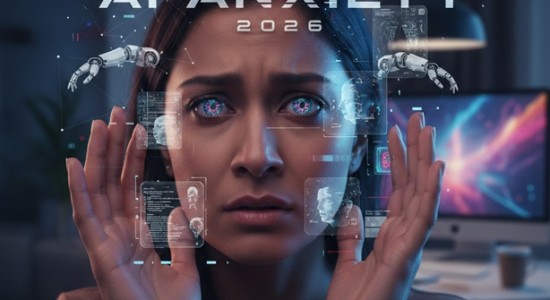
The Hook: It’s 2026, and AI isn’t just in our phones—it’s in our workflows, our creative spaces, and even our therapy apps. But as the “Silicon Colleague” becomes a permanent fixture, a new clinical phenomenon is emerging: AI Anxiety.
The Core Issue: Many of us feel a persistent “background hum” of stress regarding job security and the rapid pace of automation. Psychiatrists are increasingly seeing patients with symptoms of “Digital Dysphoria”—a sense of being overwhelmed by the inhuman speed of technological change.
Practical Takeaways:
-
The 20-20-20 Digital Rule: For every 20 minutes of interacting with AI or screens, look at something “analog” 20 feet away for 20 seconds.
-
Audit Your AI Use: Are you using AI for efficiency, or as an emotional crutch? In 2026, we’ve learned that while AI can offer data, it cannot offer empathy.
-
Set Boundaries: Just as we learned to “disconnect” from emails in the 2010s, we must now learn to “disconnect” from generative simulations to ground ourselves in human reality.
Key Thought: In a world of artificial intelligence, your human “emotional intelligence” is your greatest asset and your best defense against burnout.